Crispy Masala Dosa with Coconut Chutney: The Ultimate Authentic South Indian Recipe
Crispy golden masala dosa paired with creamy coconut chutney—a South Indian classic loved worldwide.
There are few culinary experiences as satisfying as biting into a perfectly crispy masala dosa with coconut chutney—the crackling golden exterior giving way to a soft, mildly tangy interior, wrapped around a fragrant spiced potato filling. With over 4.5 million global monthly searches for "dosa recipe" according to Google Trends data, this iconic South Indian dish has transcended borders to become a beloved breakfast and brunch staple worldwide.
Whether you are a home cook attempting your first homemade crispy dosa or a seasoned enthusiast chasing restaurant-quality results, this comprehensive guide covers everything—from the science of fermentation to the art of spreading that perfect paper-thin crepe. Let us unlock the secrets behind an authentic masala dosa recipe that delivers crunch, flavour, and that unmistakable coconut chutney creaminess every single time.
📋 Table of Contents
- What Is Crispy Masala Dosa?
- A Brief History & Origin Story
- Essential Ingredients Breakdown
- How to Make the Perfect Crispy Dosa Batter
- Spiced Potato Masala Filling
- Creamy Coconut Chutney Recipe
- 7 Secrets for an Extra-Crispy Dosa
- Dosa Varieties Comparison
- Global Trends & the Future of Dosa
- Frequently Asked Questions
What Is Crispy Masala Dosa?
A crispy masala dosa is a thin, golden-brown fermented crepe made from a rice and urad dal (black gram lentil) batter, cooked on a hot griddle until shatteringly crisp, then filled with a lightly spiced potato masala (aloo filling). It is traditionally served with coconut chutney, sambar, and sometimes a tangy tomato chutney on the side.
The hallmark of an exceptional masala dosa lies in the contrast of textures—the audible crackle of the exterior against the yielding softness of the potato filling, all brightened by the cool, creamy freshness of coconut chutney. Achieving this balance at home requires understanding a few foundational techniques, which we will explore in depth.
💡 Pro Tip: The word "dosa" (also spelled dosai or dose) originates from the Kannada word dose. In South India alone, there are over 100 documented varieties of dosa, but the masala dosa remains the undisputed king of them all.
The circular spreading technique is key to achieving an even, paper-thin dosa.
A Brief History & Origin Story
The masala dosa traces its roots to the Udupi region of Karnataka, where temple cuisine flourished centuries ago. According to food historians, the earliest written mention of "dosaka" appears in 6th-century Tamil Sangam literature, though the potato-filled masala version we love today is believed to have been popularised in the early 20th century.
Interestingly, the modern masala dosa owes much to the Udupi restaurant movement of the 1920s and 1930s, when enterprising cooks from coastal Karnataka opened eateries across Mumbai, Chennai, and eventually the world. Today, you can find masala dosa on menus from New York to Singapore, London to Dubai—a testament to its universal appeal.
"The dosa is not just food—it is a canvas. The batter is the foundation, the potato masala is the heart, and the coconut chutney is the soul."
— Traditional South Indian culinary saying
Essential Ingredients Breakdown
Understanding your ingredients is half the battle won. Here is a detailed breakdown of what goes into each component of a crispy masala dosa with coconut chutney:
For the Crispy Dosa Batter (Makes ~20 Dosas)
- Parboiled rice (idli rice) – 3 cups (480g). Short-grain rice yields the best texture. Avoid basmati.
- Whole urad dal (black gram lentil, skinned) – 1 cup (200g). This is non-negotiable for crispiness.
- Fenugreek seeds (methi) – 1 teaspoon. Enhances browning and adds that signature golden colour.
- Poha (flattened rice) or cooked rice – ¼ cup. A secret ingredient that boosts crispiness significantly.
- Rock salt (non-iodised) – 2 teaspoons. Iodised salt can inhibit fermentation.
- Filtered water – As needed for soaking and grinding.
For the Potato Masala Filling
- Potatoes (waxy variety) – 4 large, boiled and roughly mashed
- Mustard seeds – 1 teaspoon
- Curry leaves – 2 sprigs
- Green chillies – 2-3, slit lengthwise
- Onions – 2 medium, thinly sliced
- Turmeric powder – ½ teaspoon
- Ghee or coconut oil – 2 tablespoons
For the Coconut Chutney
- Fresh grated coconut – 1 cup (frozen works too; avoid desiccated for best results)
- Roasted chana dal (dalia) – 3 tablespoons
- Green chillies – 2-3
- Fresh ginger – 1-inch piece
- Tamarind paste or lemon juice – For tanginess
⚠️ Important Alert: Do not use iodised table salt in your dosa batter. Iodine interferes with the beneficial bacteria responsible for fermentation, resulting in a flat, non-crispy dosa. Always use rock salt or sea salt without additives.
How to Make the Perfect Crispy Dosa Batter
The batter is the foundation of any great crispy masala dosa. Fermentation is the magic step that transforms a simple rice-lentil mixture into a bubbling, airy batter capable of producing restaurant-quality crispiness. Here is the step-by-step process:
- Soak the rice and dal separately: Rinse the parboiled rice 3-4 times until the water runs clear. Soak it in ample filtered water for 5-6 hours. In a separate bowl, soak the urad dal along with fenugreek seeds for 4-5 hours. Separate soaking ensures optimal grinding texture.
- Grind the urad dal first: Drain the soaked dal and transfer it to a wet grinder or high-powered blender. Add cold water gradually—about ½ cup at a time—and grind for 20-25 minutes until the batter turns fluffy, smooth, and doubles in volume. A drop of batter placed in water should float.
- Grind the rice: Drain the rice and grind it along with the poha to a slightly coarse paste—not completely smooth. This slight grittiness contributes to the final crispiness. Use minimal water.
- Combine and ferment: Mix both batters together in a large stainless steel or ceramic bowl. Add rock salt and stir vigorously with your hand for 2-3 minutes—the warmth from your hand introduces beneficial bacteria that aid fermentation. Cover with a lid and place in a warm spot (ideally 28°C to 32°C / 82°F to 90°F) for 8-12 hours.
- Check readiness: A properly fermented batter will have risen significantly, show tiny bubbles on the surface, and emit a pleasant, mildly sour aroma. If your kitchen is cold, place the bowl inside an oven with just the pilot light on, or use the Instant Pot yogurt setting.
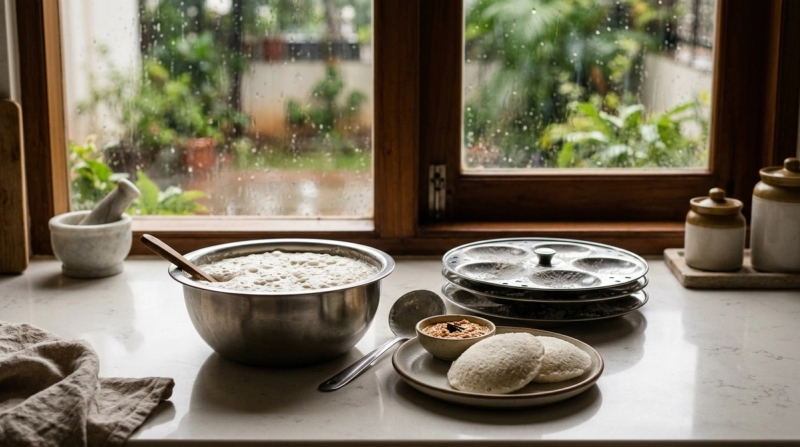
A well-fermented batter displays numerous tiny air pockets—the secret behind that coveted crispy texture.
Spiced Potato Masala Filling (Aloo Masala)
The potato masala is the soul of a masala dosa. It should be flavourful but not overpowering, moist but not wet, allowing the dosa to remain crisp. Here is the authentic method:
- Heat 2 tablespoons of ghee (or coconut oil for a vegan version) in a kadai or wide pan over medium heat.
- Add 1 teaspoon mustard seeds and let them splutter completely—about 30 seconds.
- Toss in 2 sprigs of fresh curry leaves, 2-3 slit green chillies, and 1 teaspoon chana dal. Sauté for 45 seconds until fragrant.
- Add 2 thinly sliced medium onions and cook until translucent and lightly golden—around 5-6 minutes.
- Sprinkle ½ teaspoon turmeric powder and a pinch of asafoetida (hing). Stir well.
- Add the boiled and roughly mashed potatoes along with salt to taste. Mix thoroughly.
- Splash in 2-3 tablespoons of water, cover, and simmer on low heat for 4-5 minutes so the flavours meld.
- Finish with a squeeze of fresh lemon juice and chopped coriander leaves.
The filling should hold its shape when scooped but retain a slight creaminess. Avoid making it too dry, as the residual moisture gently steams the dosa from within, enhancing the overall eating experience.
Creamy Coconut Chutney Recipe
No crispy masala dosa is complete without a luscious coconut chutney on the side. This recipe yields a chutney that is creamy, mildly spiced, and perfectly balanced—the ideal companion to the crispy dosa and spiced potato filling.
Chutney Base:
- 1 cup fresh grated coconut
- 3 tablespoons roasted chana dal (dalia)
- 2-3 green chillies (adjust to taste)
- 1-inch piece of fresh ginger
- ½ teaspoon tamarind paste or 1 teaspoon lemon juice
- Salt to taste
- ¼ cup cold water (for blending)
Tempering (Tadka):
- 1 teaspoon coconut oil
- ½ teaspoon mustard seeds
- 1 sprig curry leaves
- 1 dried red chilli
Blend all base ingredients until smooth and creamy, adding water gradually. The chutney should be thick yet pourable. Prepare the tempering by heating oil, adding mustard seeds until they splutter, then the curry leaves and dried chilli. Pour the sizzling tempering over the chutney and stir. The aroma at this stage is absolutely intoxicating.
Fresh coconut chutney with a fragrant mustard seed tempering—the essential sidekick.
7 Secrets for an Extra-Crispy Dosa Every Time
Achieving that restaurant-style crackle requires more than just a good batter. Here are seven professional secrets that elevate your crispy masala dosa from good to unforgettable:
- Use a cast-iron tawa (griddle): Cast iron retains and distributes heat evenly, creating the ideal surface for crisping. Season it well and dedicate it exclusively to dosas if possible.
- The onion rub trick: Before pouring batter, rub the hot tawa with a halved onion dipped in oil. This creates a natural non-stick coating and imparts a subtle flavour.
- Sprinkle water before each dosa: Splash a few drops of cold water on the hot tawa and wipe clean with a cloth. This brings the surface temperature to the optimal range—around 180°C to 200°C (356°F to 392°F).
- Spread from the centre outward: Using the back of a flat ladle, start at the centre and spiral outward in one continuous motion. This technique ensures uniform thinness.
- Drizzle oil or ghee around the edges: Adding fat around the perimeter of the dosa crisps the edges beautifully. Ghee adds unmatched flavour.
- Cook uncovered on medium-high heat: Resist the urge to cover the dosa while cooking. Steam trapped under a lid softens the exterior. Let it cook open for maximum crispiness.
- Fill only after flipping: Cook the first side until golden, flip briefly, then add the potato masala on the cooked side. This keeps the outer surface protected and ultra-crispy.
Dosa Varieties Comparison Table
Understanding how the crispy masala dosa stacks up against other popular dosa varieties helps you appreciate its unique qualities:
Global Use Cases: How the World Enjoys Masala Dosa
The crispy masala dosa with coconut chutney has travelled far beyond South India. Here is how different cultures and settings have embraced this versatile dish:
- Weekend Brunch Staple (USA & UK): Indian restaurants in cities like London, New York, and San Francisco report masala dosa as their top-selling brunch item, often paired with craft chai or even a mimosa.
- Gluten-Free Hero: With celiac disease affecting approximately 1 in 100 people globally, the naturally gluten-free dosa has become a go-to option for those avoiding wheat. It is now featured on gluten-free menus across Europe and Australia.
- Vegan-Friendly Powerhouse: When cooked with coconut oil instead of ghee, the masala dosa is entirely plant-based, making it a darling of the vegan movement. The global vegan food market, valued at $16.5 billion in 2023, increasingly features dosa in ready-to-eat formats.
- Street Food Innovation: Food trucks from Los Angeles to Melbourne have reimagined the masala dosa as a portable wrap, incorporating fusion fillings like paneer tikka, barbecue jackfruit, and even Mexican-inspired bean masala.
- Fine Dining Interpretation: Michelin-starred chefs have deconstructed the masala dosa into elegant tasting menus, serving miniature crisp dosa cones filled with truffle-infused potato mousse and coconut foam.
Future Trends: Where Is Dosa Heading?
The global appetite for authentic South Indian cuisine shows no signs of slowing. Industry analysts project the Indian food market to reach $200 billion by 2030, with dosa-related products accounting for a significant share of the ready-to-cook segment. Here are key trends shaping the future:
- Ready-to-Cook Dosa Batter Kits: Brands are innovating with shelf-stable, pre-fermented batter pouches that deliver fresh-tasting dosa in under 5 minutes—no grinding or fermentation required.
- Sustainable Ingredients: Millet-based dosa batters (ragi, jowar, bajra) are gaining traction as consumers seek climate-resilient grains. These multigrain versions offer higher fibre and protein content.
- AI-Powered Cooking Appliances: Smart tawas with temperature sensors and automated batter dispensers are being developed, promising perfectly even dosas at the touch of a button.
- Coconut Chutney Innovations: Chefs are experimenting with flavoured chutneys—curry leaf-infused, roasted garlic, and even beetroot-coconut variations—to complement the classic crispy masala dosa.
Frequently Asked Questions (FAQ)
Q1: Why is my dosa not turning crispy?
The most common reasons are: (a) the batter was not fermented sufficiently—it needs 8-12 hours in a warm environment; (b) the tawa was not hot enough—aim for 180°C-200°C; (c) the batter was too thick, preventing it from spreading paper-thin; (d) you covered the dosa while cooking, trapping steam. Check these four factors for immediate improvement.
Q2: Can I make crispy masala dosa batter without a wet grinder?
Yes. A high-powered blender (like a Vitamix or Indian mixie) works well. The key is to grind the urad dal with very little cold water—adding ice cubes helps prevent overheating—and to blend in short pulses, scraping down the sides frequently. The texture may be slightly less fluffy than a wet grinder, but the crispiness will still be excellent.
Q3: How long can I store dosa batter and coconut chutney?
Fermented dosa batter can be refrigerated for up to 5-7 days. Stir well before each use. Coconut chutney stays fresh for 2-3 days in an airtight container in the refrigerator. For longer storage, freeze the chutney in ice cube trays for up to 1 month—thaw individual portions as needed.
Q4: Is masala dosa healthy?
Absolutely. A single masala dosa provides approximately 250-300 calories, with complex carbohydrates from fermented rice and lentils, protein from urad dal (around 8-10g per dosa), and healthy fats if cooked with minimal oil. The fermentation process also enhances nutrient bioavailability and introduces gut-friendly probiotics.
Q5: Can I make this recipe completely vegan?
Yes. Simply replace ghee with coconut oil or a neutral vegetable oil when cooking the dosa and preparing the potato masala. The coconut chutney is naturally vegan when the tadka is done with coconut oil. The batter itself contains no animal products. The result is a 100% plant-based, gluten-free meal.
Q6: What is the best substitute for curry leaves?
Curry leaves have a unique citrusy, slightly nutty flavour that is hard to replicate precisely. The closest substitutes are: (a) lime zest combined with fresh basil for a similar aromatic profile; (b) kaffir lime leaves (use sparingly); or (c) simply omitting them—your dosa will still be delicious. However, for an authentic crispy masala dosa, sourcing curry leaves (fresh or frozen) is highly recommended.
Q7: Why does my dosa stick to the pan?
Sticking occurs when: (a) the tawa is not properly seasoned (for cast iron); (b) the surface temperature is too low; (c) you did not perform the onion rub technique; or (d) the batter is too thin. A well-seasoned, properly heated tawa with a light oil coating should release the dosa effortlessly. If sticking persists, sprinkle a few drops of water, wipe clean, and re-season the surface with oil before the next attempt.
Conclusion: Your Journey to the Perfect Crispy Masala Dosa
Mastering the crispy masala dosa with coconut chutney is a rewarding culinary journey that connects you with centuries of South Indian tradition. From the patient fermentation of the rice-lentil batter to the aromatic sizzle of mustard seeds in the potato masala, every step is an act of mindful cooking. The result—a golden, crackling dosa filled with spiced potatoes and accompanied by cool, creamy coconut chutney—is nothing short of magical.
Remember that practice makes perfect. Your first few dosas may not be Instagram-worthy, but each attempt teaches you something valuable about heat control, batter consistency, and spreading technique. Before you know it, you will be confidently flipping restaurant-quality crispy masala dosas in your own kitchen, much to the delight of family and friends.
🔥 Ready to Make Your Own Crispy Masala Dosa?
Gather your ingredients, follow this guide step by step, and experience the joy of creating an authentic South Indian masterpiece at home. Tag us in your dosa photos—we would love to see your golden, crispy creations!
📌 Save this recipe for later | 💬 Leave a comment below | 🔗 Share with a fellow food lover
The complete experience—crispy masala dosa, coconut chutney, sambar, and a steaming cup of filter coffee.
🏷️ Tags / Keywords
Crispy Masala Dosa Coconut Chutney Recipe South Indian Dosa Masala Dosa Recipe Crispy Dosa Batter Potato Masala Filling Fermented Dosa Indian Breakfast Homemade Dosa Gluten-Free Recipe Vegan Dosa Authentic Indian Food
📎 Suggested Internal Links (replace with your blog URLs):
• Authentic South Indian Sambar Recipe — The perfect accompaniment
• How to Make Traditional Filter Coffee — Complete your South Indian breakfast
• Crispy Medu Vada Recipe — Another South Indian breakfast classic
🔗 External References: